

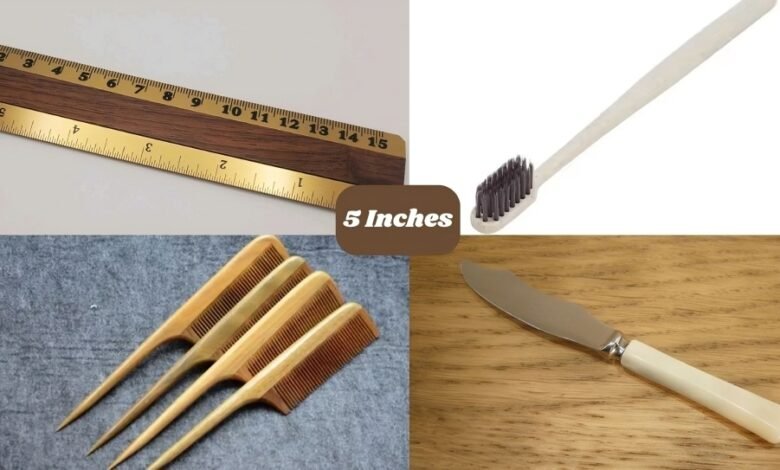
When someone mentions 5 inches, it can sound straightforward at first. But unless you have a ruler nearby, visualizing exactly how long 5 inches really is can be surprisingly difficult. People search for 5 inches for many reasons. Some want to compare measurements for household items, others need a quick size reference while shopping online, and many are simply curious about how it translates into everyday objects they already know.
The truth is that 5 inches is easier to picture when you connect it to things you see around you every day. While rulers and measuring tapes are helpful, real-world comparisons often make the measurement feel much more practical. Instead of thinking in abstract units, you can imagine objects sitting on your desk, in your pocket, or around your home.
Understanding 5 inches also matters because this measurement appears often in daily life. Phone screens, notebooks, kitchen tools, hand sizes, and decorative items are frequently described using inches. If you can confidently picture 5 inches, it becomes much easier to buy products online, plan projects, and estimate dimensions quickly.
This guide breaks down exactly what 5 inches looks like, how it compares with familiar items, how it converts into other units, and why this simple measurement matters more than most people realize.
Understanding 5 Inches in Basic Terms
To understand 5 inches, it helps to start with the exact measurement. One inch equals 2.54 centimeters. That means 5 inches equals 12.7 centimeters.
That may sound more precise, but centimeters do not always help if you are trying to picture something quickly. Real-world examples are usually much easier.
5 inches is slightly longer than the width of many adult hands. It is long enough to notice immediately, but short enough to fit comfortably in your palm or pocket.
When placed on a ruler, 5 inches reaches from the zero mark to the number five. Visually, it feels like a moderate distance—larger than tiny objects, but much smaller than a foot.
Because 5 inches sits right in the middle of many common sizes, it often feels familiar once you compare it to things around you.
What Does 5 Inches Look Like in Everyday Life?
The easiest way to understand 5 inches is through practical examples.
A standard smartphone is often close to 5 inches tall or slightly longer depending on the model. If you hold your phone upright, you already have a useful visual reference.
A dollar bill is about 6.14 inches long, which means 5 inches is slightly shorter than a bill.
A typical index card can help too. A 5×7 card includes 5 inches exactly on one side.
A medium kitchen knife blade often measures around 5 inches.
Many paperback books also have dimensions close to 5 inches across.
These comparisons matter because they turn 5 inches from a number into something easy to picture.
The next time someone asks how big 5 inches is, you may instantly think of a phone, a knife blade, or an index card.
Why Visualizing 5 Inches Matters
At first glance, 5 inches might seem like a random measurement. But in real life, it matters often.
When shopping online, product descriptions frequently mention 5 inches. Without a visual reference, buyers sometimes misunderstand the actual size.
Home decorating is another common example. A picture frame listed as 5 inches wide may look very different than expected if you cannot picture it accurately.
Craft projects also depend on clear measurements. Cutting paper, choosing materials, or organizing shelves becomes easier when 5 inches feels familiar.
Even clothing accessories can involve 5 inches. Wallets, clutches, belts, and jewelry sizing sometimes rely on that exact dimension.
Being able to picture 5 inches quickly helps you make faster and more confident decisions.
How 5 Inches Compares to Other Measurements
Understanding 5 inches becomes easier when compared with nearby measurements.
Four inches feels noticeably smaller. The difference may seem tiny on paper, but visually it stands out.
Six inches feels longer and starts approaching half a foot.
Since twelve inches equals one foot, 5 inches is a little less than half a foot.
In centimeters, 5 inches becomes 12.7 cm.
In millimeters, 5 inches equals 127 mm.
These comparisons are especially useful for international measurements since many countries use centimeters instead of inches.
Whether you are measuring furniture or comparing a product description, understanding where 5 inches sits between larger and smaller units makes it easier.
Common Household Items Around 5 Inches
Many items at home are surprisingly close to 5 inches.
A small notebook may be around 5 inches wide.
A remote control’s compact versions often measure close to 5 inches.
Some candles are sold in 5-inch heights.
A toothbrush can have a handle section close to 5 inches.
A medium spoon or kitchen utensil can also be near 5 inches.
A decorative plant pot may measure 5 inches across.
Because so many items match this size, 5 inches becomes much easier to remember over time.
You start noticing it naturally.
Is 5 Inches Considered Big or Small?
Whether 5 inches feels large or small depends entirely on context.
For jewelry, 5 inches can feel fairly large.
For a bookshelf, 5 inches is very small.
For a smartphone screen, 5 inches feels normal.
For a kitchen drawer handle, 5 inches may feel long.
That is why context matters so much.
The measurement itself stays the same, but our perception changes depending on what we compare it with.
This explains why people often ask how big 5 inches really is.
Without context, numbers feel abstract.
With comparison, the size becomes obvious.
Using Your Hand to Estimate 5 Inches
A very practical trick is using your hand.
Many adult palms measure around 4 to 4.5 inches across.
That means 5 inches is slightly wider than the palm.
From fingertip to mid-palm can also approach 5 inches depending on hand size.
This makes hand estimation useful when you do not have measuring tools nearby.
It is not exact, but it gives a reliable mental picture.
Once you connect 5 inches with your hand, estimating becomes much easier.
Shopping Online and Understanding 5 Inches
One of the most common reasons people search 5 inches is online shopping.
A product image can be misleading.
Without a size reference, a 5-inch item may appear bigger or smaller than expected.
A 5-inch vase may look large in photos but feel compact in person.
A 5-inch device may fit in your pocket more easily than expected.
Understanding 5 inches helps reduce buying mistakes.
It also improves confidence when reading product dimensions.
That simple mental picture saves time and frustration.
Why 5 Inches Appears So Often
There is a reason 5 inches feels common.
Manufacturers often design products around practical hand-held dimensions.
Items near 5 inches are easy to hold, store, and transport.
That makes 5 inches a very practical measurement.
It balances convenience and visibility.
Not too small.
Not too large.
That middle ground explains why 5 inches appears frequently in homes, stores, and product packaging.
Conclusion
Understanding 5 inches becomes much easier once you connect the measurement with everyday life.
Instead of imagining ruler marks, think about real objects.
A smartphone, an index card, a notebook, or the width of your hand can instantly make 5 inches feel familiar.
That matters more than people expect.
Whether you are shopping online, measuring for home décor, working on crafts, or simply satisfying curiosity, visualizing 5 inches helps you make quicker and more accurate decisions.
The next time you see 5 inches written in a product description or measurement guide, you will likely picture it immediately.
And once you can do that, this once-abstract measurement becomes simple, practical, and easy to understand.
FAQs About 5 Inches
How many centimeters is 5 inches?
5 inches equals exactly 12.7 centimeters.
What object is about 5 inches long?
A medium smartphone, a kitchen knife blade, or one side of a 5×7 index card is often close to 5 inches.
Is 5 inches half a foot?
Not exactly. Since a foot is 12 inches, 5 inches is slightly less than half a foot.
Can I estimate 5 inches without a ruler?
Yes. Your hand, a smartphone, or a small notebook can help estimate 5 inches quickly.
Why do people search how big 5 inches is?
Most people want quick visual comparisons for shopping, measuring items, home projects, or understanding dimensions in daily life.
Read More: